Parametric FPV quad designer
249 grams.
Battery included.
Poltergeist is a parametric designer for 3D-printed FPV quads. Live mass, thrust and flight-time verdicts. Real FEA with its assumptions on the table. One print button, wired to your farm. Everything under the sub-250 g line — on purpose.

FIG. 01 — The mass budget
Every gram has to
earn its seat.
The budget bar is the designer's spine — parts check in, attribution stays per-part, and the verdict flips the moment you cross the line. Scroll to build one.
FIG. 02 — The designer
Parameters in.
Verdicts out.
This panel isn't a screenshot — drag the wheelbase. Frame mass, all-up weight and thrust margin recompute mid-drag, the same arithmetic the engine runs on every edit. No apply button, no “recalculate.” The design is the number.
The wheelbase carries over exactly. The masses don't — the studio weighs the plate it renders, not this power-law stand-in.
Open 145 mm in the studioFIG. 03 — The physics
Real FEA, with
its homework shown.
Punch-outs break arms at the root, so that's where we look. Stress fields on the printed geometry, a safety factor against your material's real yield — and the assumptions pinned right next to the PASS, where they belong.
ASSUMPTIONS SHIP WITH THE VERDICT.
FIG. 04 — The envelope
Know your hover
before you print.
Thrust curves from bench data, current draw against your battery's C-rating, flight time with a discharge floor you set. The envelope is computed while you design — not discovered in a field.
FIG. 04A — The receipt
Trust, but derate.
Two benches, one motor class, a 2.2× disagreement. This is why every verdict on this page runs on half the datasheet — scroll the receipt.
T-Motor's bench: 393 g per motor at full throttle, 16.8 V, GF4024-2 prop — filed with URL, capture date and bench conditions.
RCbenchmark's Flywoo 1404, same prop spec, read 175 g at matched RPM — 2.2× under the claim. A different maker's 1404, so it stays a cross-check, never a registry row.
Decision #9: manufacturer tables run derated ×0.5 until our own rig measures. The halved curve lands within 9% of the stand, and every figure above inherits the assumption.
FIG. 04B — The verdict strip
Load it up.
Watch it argue.
They claim 1401 g of thrust; we model 700. This is the studio's real verdict surface, running in your browser on the halved table — pick a pack, add payload, cross the line.
ASSUMES: Estimated (non-registry) masses in the ledger: unibody-frame (27.2 g × 1), vtx-antenna (10.1 g × 1), elrs-rx (1.9 g × 1), hardware (11 g × 1).
ASSUMES: Authored thrust derated to 50% (decision #9) — manufacturer table @ 16.7 V (hqprop-t35x2x3).
ASSUMES: Hover point EXTRAPOLATED below the table's 50% throttle floor (lowest bench row) — linear on the two lowest rows.
ASSUMES: Current interpolated raw from the same bench rows (thrust derated, current not — the conservative pairing).
ASSUMES: Hover-only figure: no maneuvering, no avionics/VTX load in the amps.
ASSUMES: C ratings are marketing numbers; sustained draw near the limit sags hard.
Same pack, same payload, same two solvers — these numbers survive the click. What the studio adds is everything upstream of them: the parts, the frame, and the plate itself, rendered and weighed.
Open this in the studioNumbers, not vibes.
Every figure here is computed from the registries and their bench data — imported, never typed. What the engine can’t compute yet wears an est mark; if we can’t compute it, we don’t print it.
Assumptions on the table.
A verdict without its assumptions is a vibe with a font. Material, orientation, load case, mesh — attached to every PASS, travelling with the file.
The line is the design.
249 g isn’t squeezed under at the end. It’s the first number in the file — battery included, as the FAA counts it — and every part negotiates with it.
Screw stops inside the mount base.
ASSUMES: Screw length is under-head thread length (socket-cap convention).
FIG. 07 — The round trip
Send the plate.
Get grams back.
Pair a farm once and the printer picker fills itself in. The plate goes on the bed, the AMS slot is matched by material family, and the job slices and then waits — nothing starts a physical print without a press. Then the return leg, which is the part worth building: the slicer’s own grams replace the modelled mass on the ledger, walls and skins included, and every verdict above re-derives from a number that came off a machine instead of out of a density table.
FIG. 05 — From the field
Built with Poltergeist.
Flown anyway.
Unibody frames off home printers, checked by the engine, carried into weather the renderings never promised. The embossed revision QR in the DETAIL frame is PH6 — the photograph is ahead of the software, and we would rather say so than let you assume.
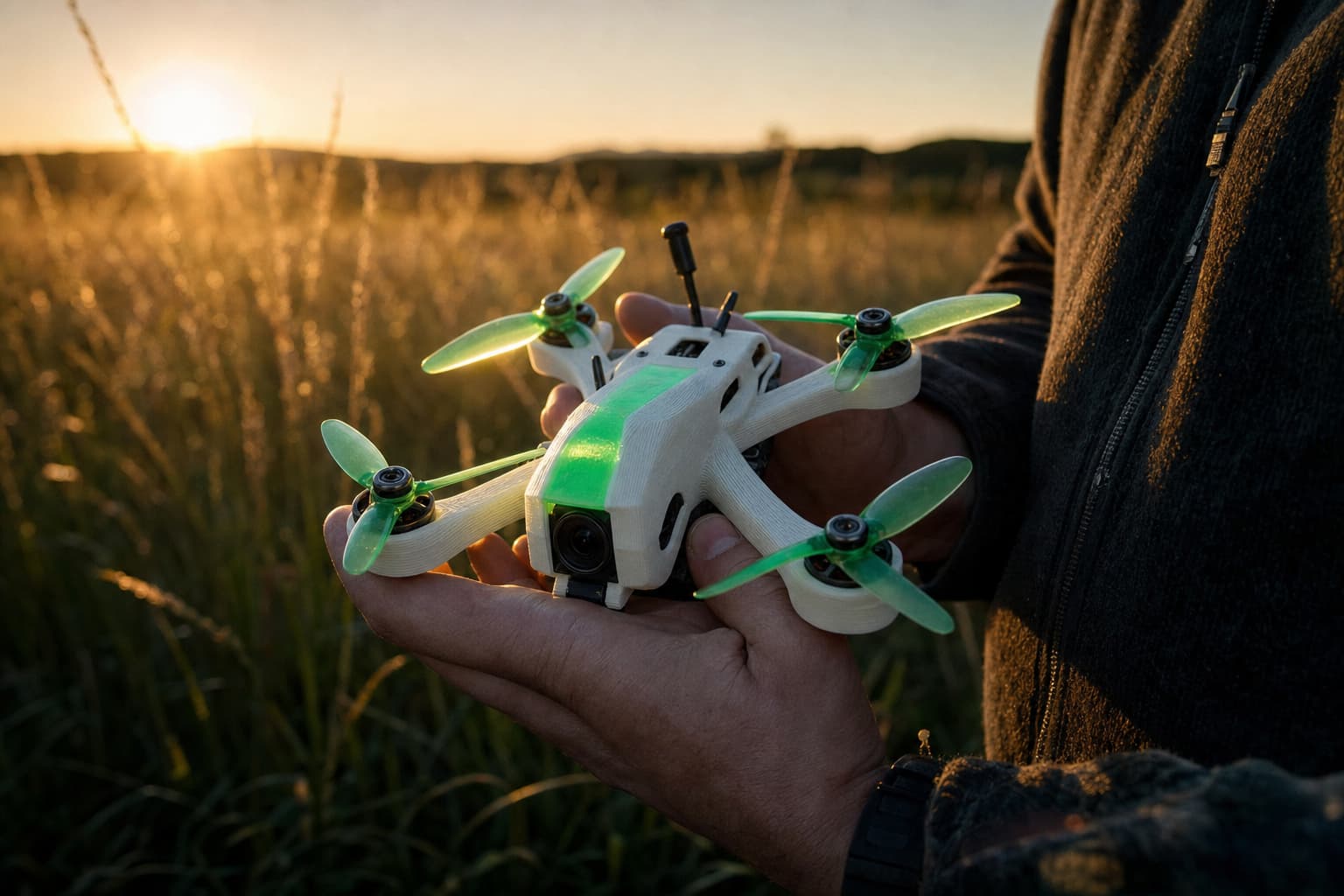
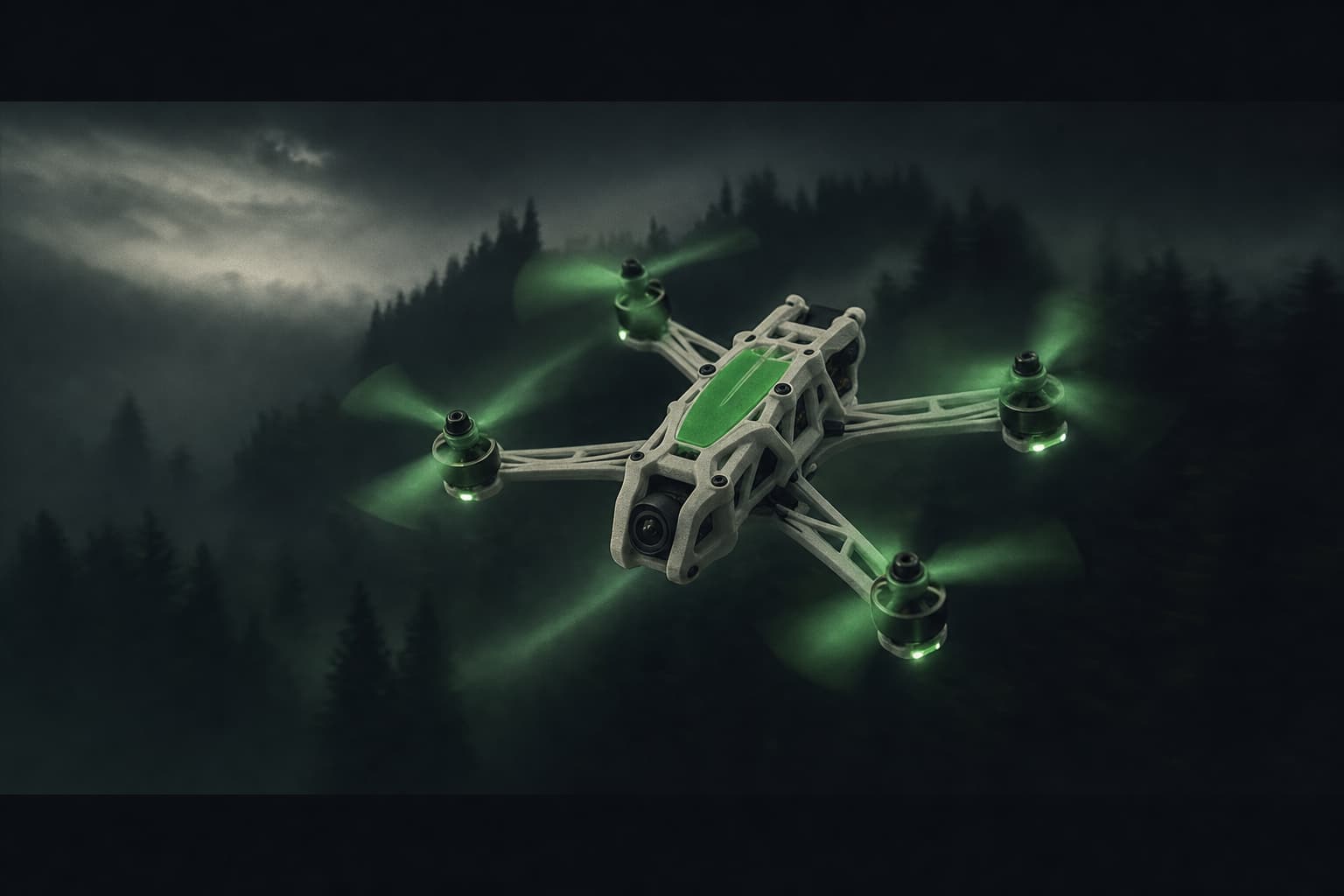
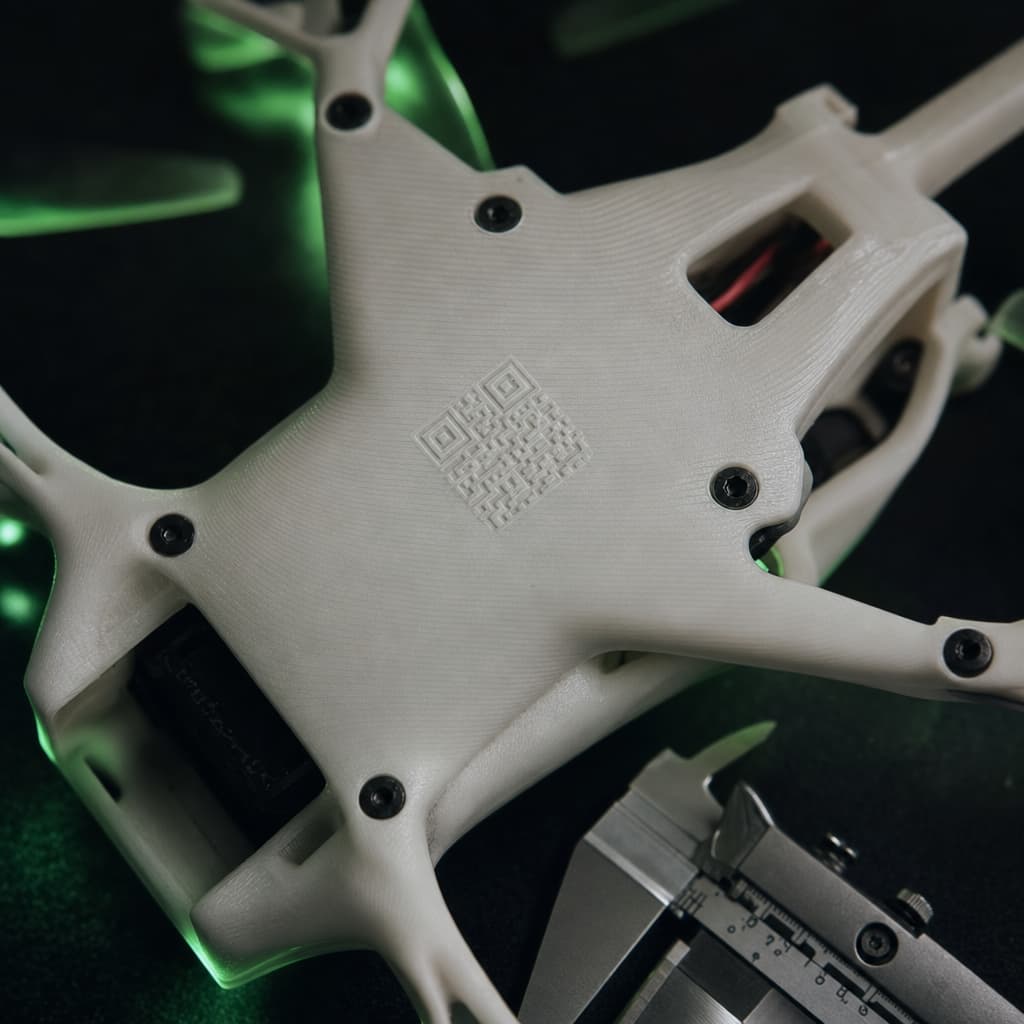
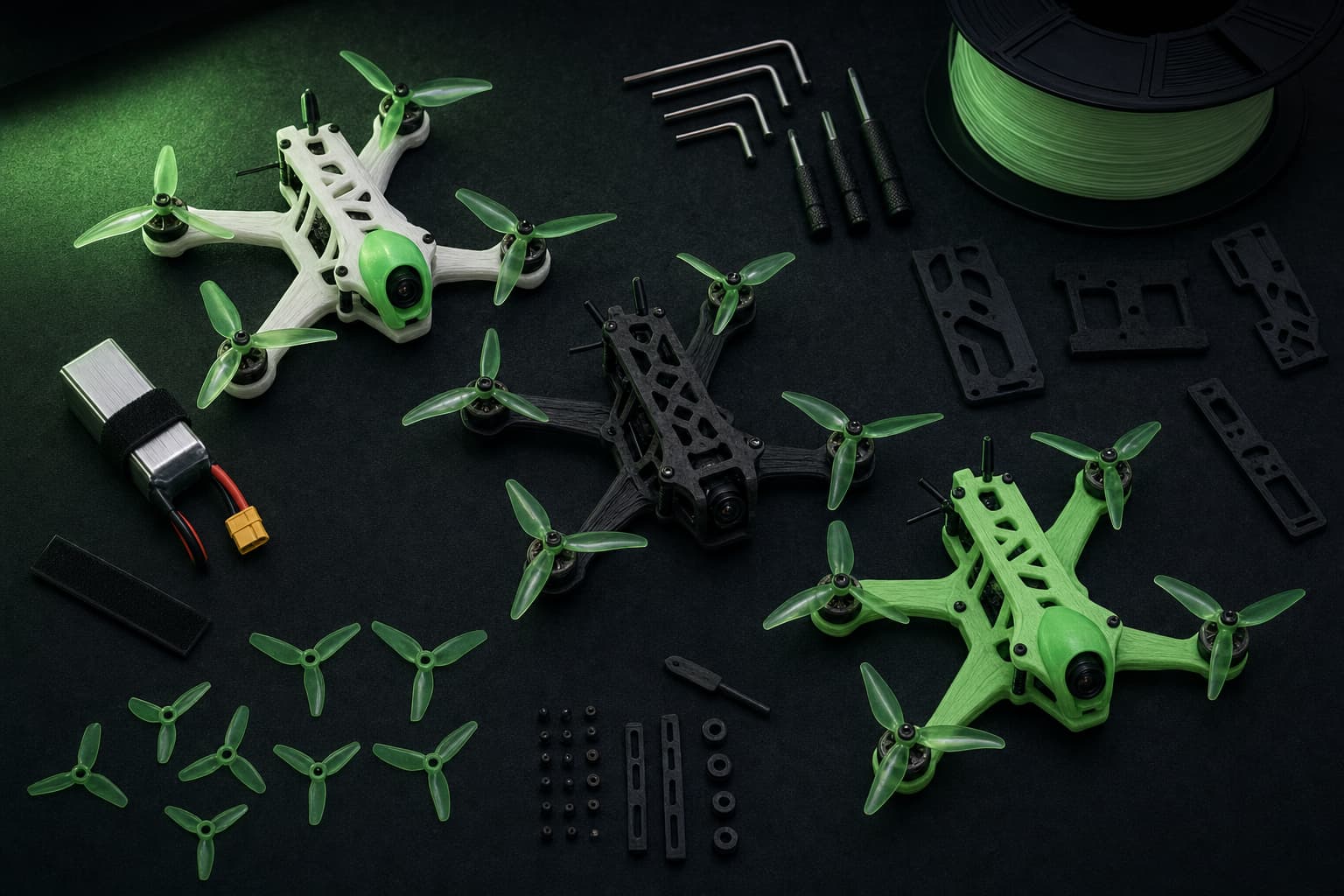
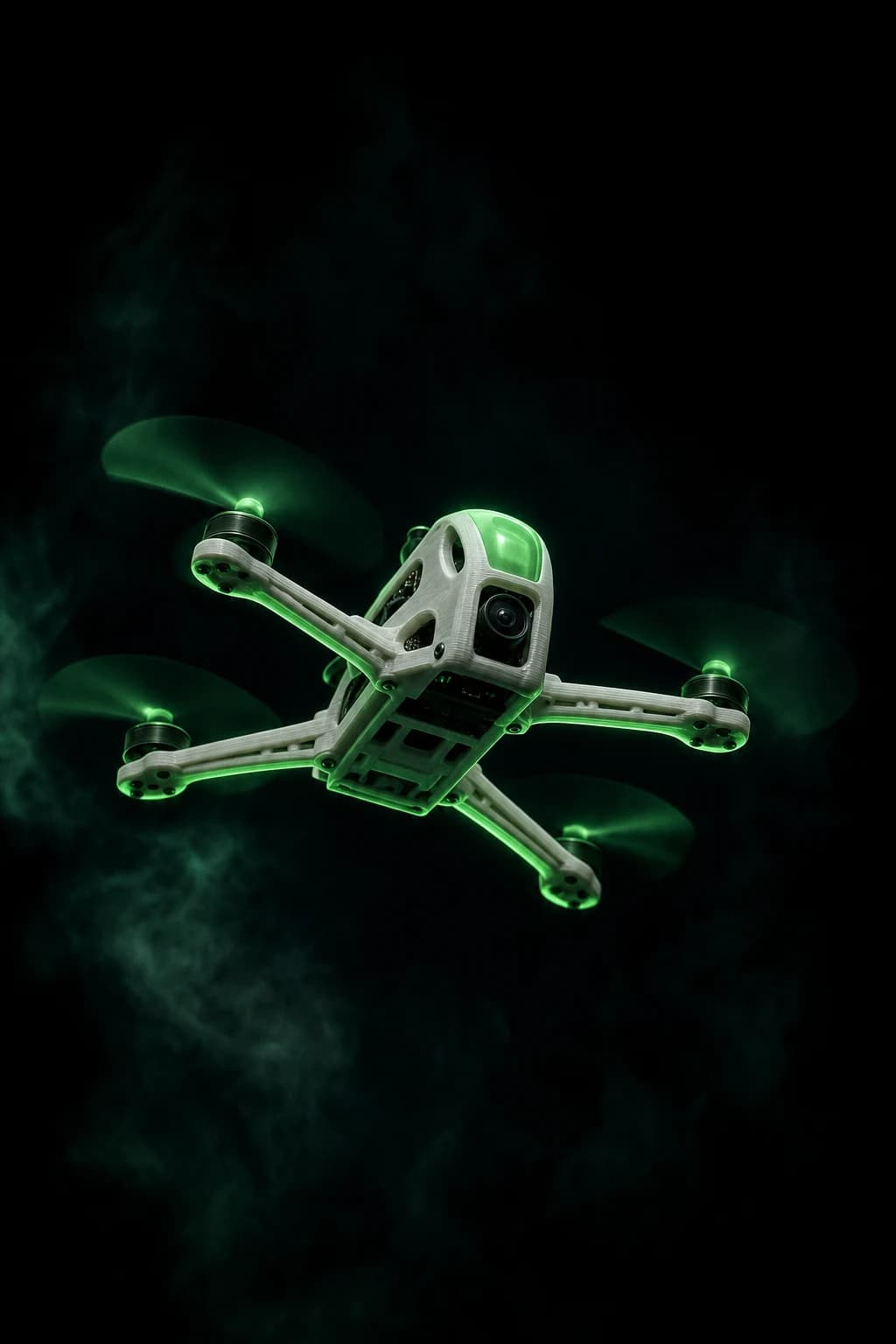
FIG. 06 — The loop
Sketch at dinner.
Fly before work.
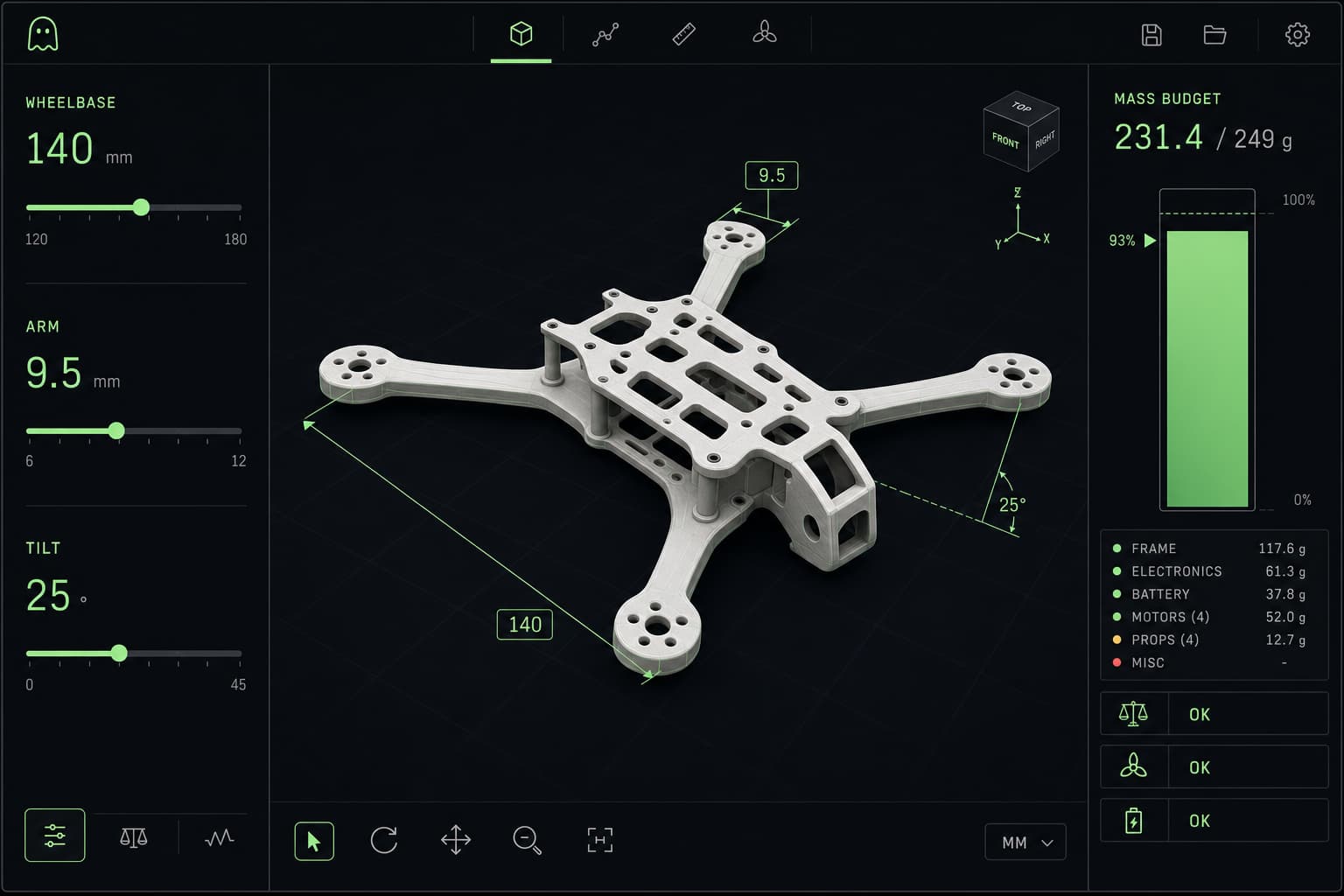
Drag a wheelbase. The mass ledger re-totals mid-drag.
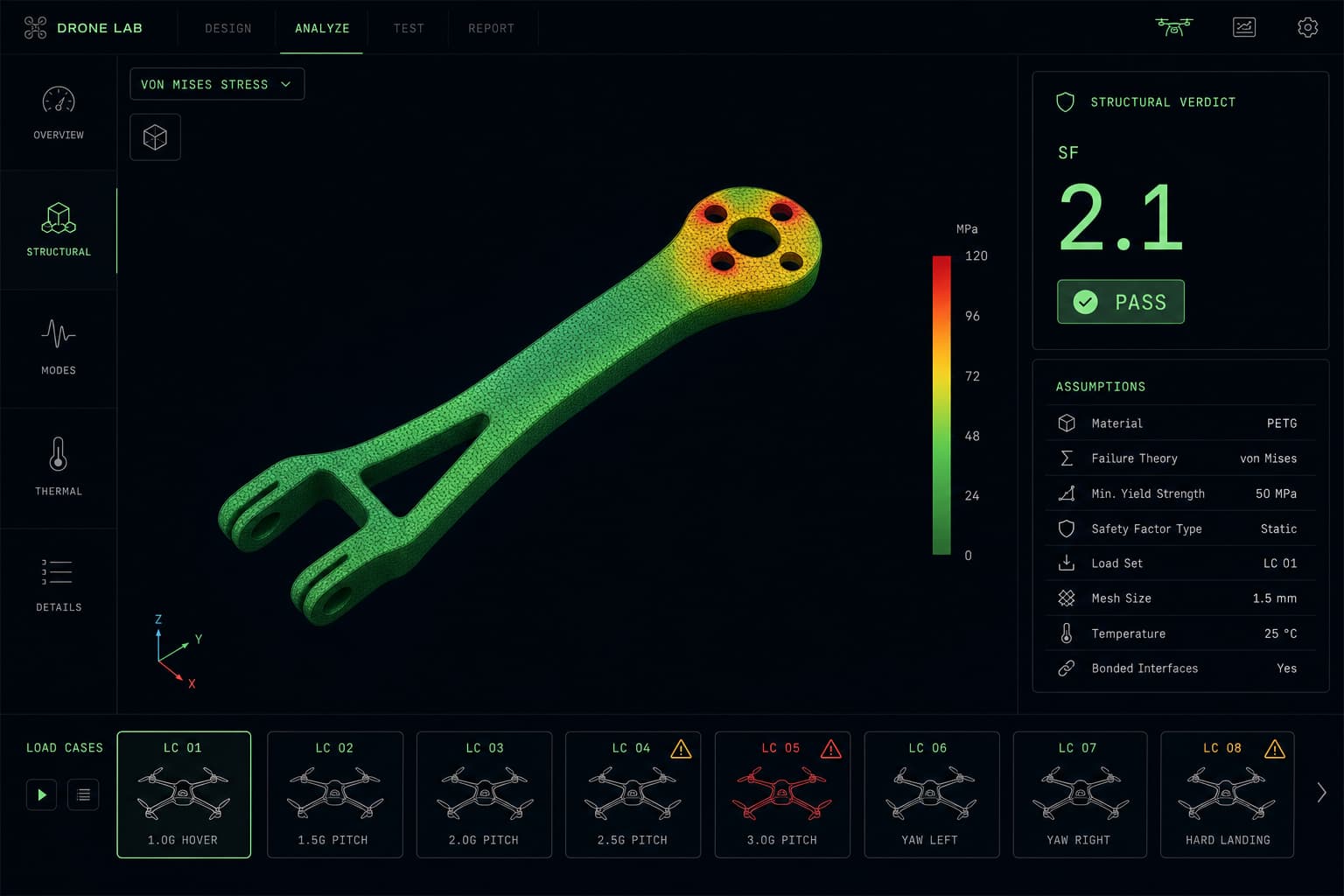
FEA on the printed geometry, assumptions attached.
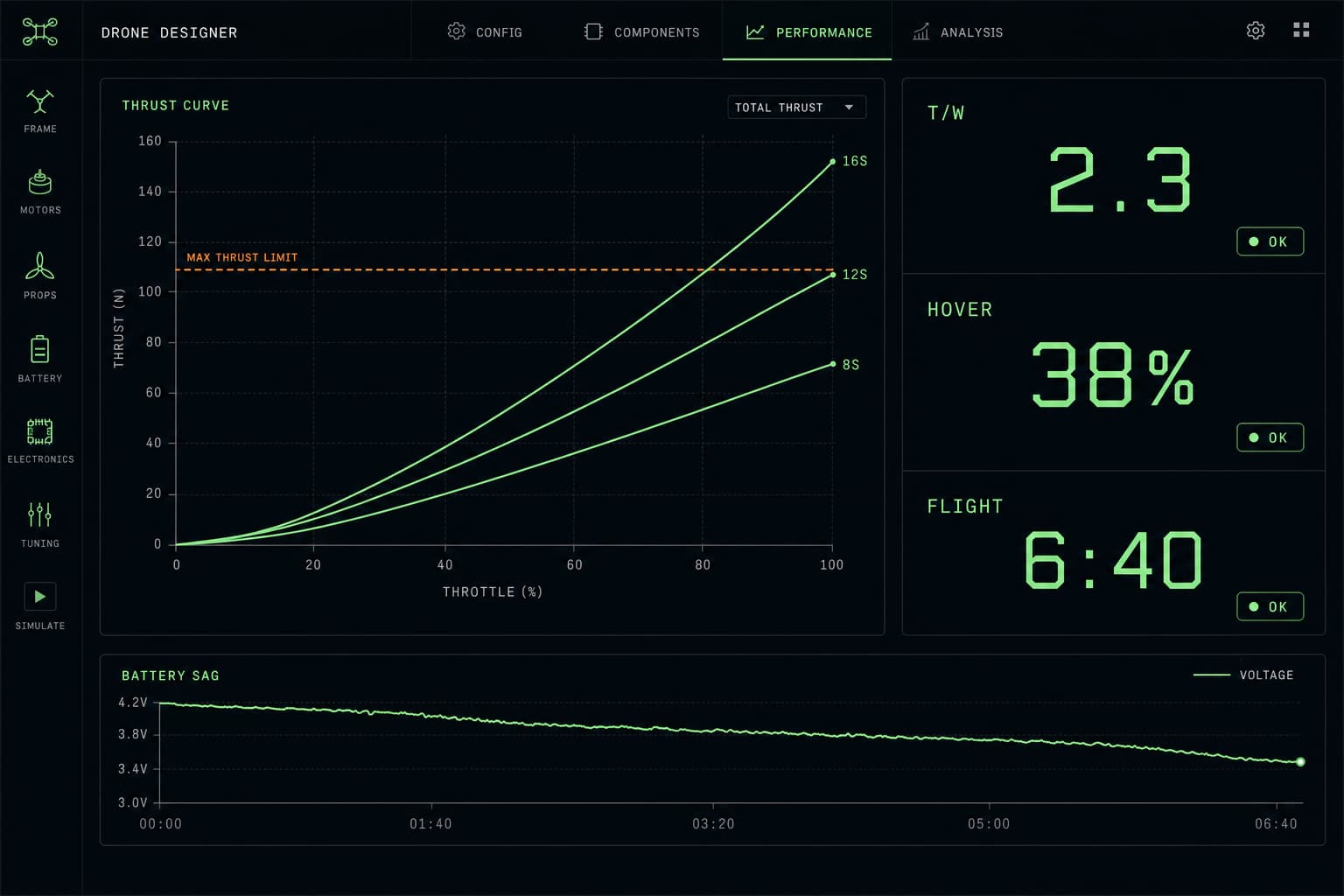
Thrust, hover and flight time against your battery.
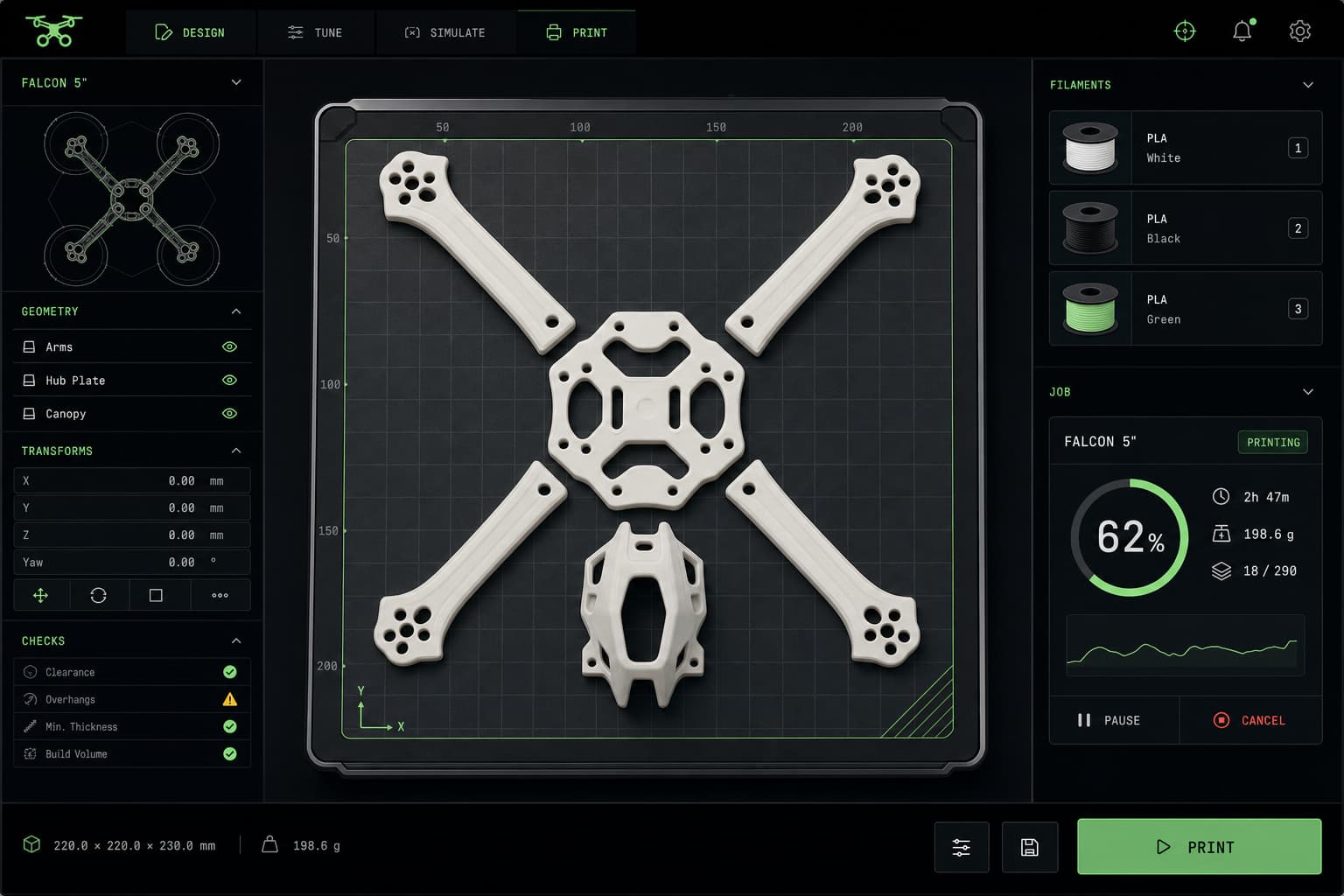
One button to the farm. The slicer’s grams come back.